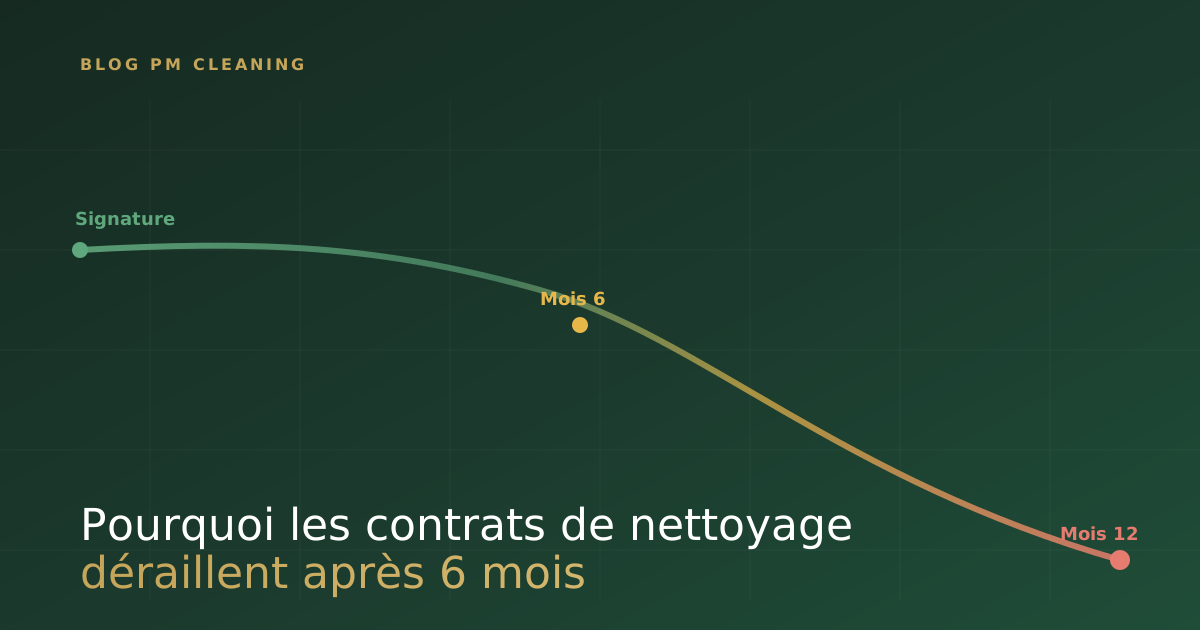
A cleaning contract never derails all at once. It always starts with a detail. A bin overflowing on a Tuesday. A dusty skirting board behind a piece of furniture. An invoice that includes a "surcharge" no one understands. 6 to 9 months in, the facility manager realises that what was signed no longer matches what is being delivered. The good news: these derailments almost always follow the same 5 root causes. And they are repairable.
The silent pattern of the first 6 months
In most cases we encounter in the field, the scenario is the same. The provider arrives in "conquest" mode: fresh teams, project manager present, quick adjustments. For 90 days everything is flawless. The client relaxes, stops watching, and lowers contract vigilance. That is precisely the window in which the provider starts optimising production cost.
From month 4, the passes get shorter. From month 6, one or two people from the original team have left or been reassigned. From month 9, internal complaints appear, but it is already hard to objectify them because no one documented the starting state. This is the contract's "memory gap": everyone senses quality has dropped, nobody can prove it.
Key takeaway
Quality is not a state, it is a curve. A contract signed at 100/100 rarely lives long above 85/100 without an active maintenance mechanism.
5 root causes of derailment
1. Price pressure at signing
This is the root cause. When a provider accepts a rate that puts them under pressure from day one, they cannot hold for 24 months. They absorb unforeseen events for 3 to 6 months (sick-leave cover, extra consumables, unplanned hours) then silently cut the real service to recover a margin. The client sees nothing because the drop is gradual and spread across all zones.
An abnormally low price is not a good deal. It is a promise that will only hold as long as the provider can afford to lose money on your contract.
2. Scope creep nobody records
Between month 1 and month 6, the client adds small requests: "while you are at it, could you vacuum under the sofa?", "when the meeting room is empty, could you clean the walls?". Individually, nothing serious. Cumulated over 20 micro-requests, you have added the equivalent of 2 hours per month to a contract whose price has not moved.
The provider accepts, because a frontal refusal damages the relationship. But they compensate elsewhere: a zone skips a week, a cheaper product replaces the original, a pass is cut short. Invisible scope creep creates visible quality loss.
3. Operator rotation
A cleaning contract is carried by people. The person who knows your building, who knows reception is sensitive to product smell, who has the reflex to wipe behind the coffee machine, is an intangible asset. Every time they leave, site knowledge leaves with them.
Large providers have an average turnover of 40 to 70% a year on some site types. That means the person who starts at your place in January will probably be gone by September. And the one replacing them starts from zero, with no formal briefing, because the project manager no longer comes on site.
4. Response time to remarks
A healthy contract has a single, fast channel: one person, one number, a same-day reply. A derailing contract has a journey: online form, automated acknowledgement, routing to a manager, reply within 72 hours, action within 2 weeks. The delay is not a detail: it is the quality itself. A remark made and not handled for 3 weeks creates a precedent: the next time, the client says nothing.
5. No review cadence
Most contracts have no formal review. Not quarterly, not half-yearly. The provider comes every day but nobody sits down to look at what worked, what dropped off, what should change. Without cadence, the contract becomes invisible, and the invisible always derails.
4 early signals a contract is coming off
When derailment is underway, it leaves traces. Here are the 4 signals that appear before quality visibly collapses:
- Visible rotation. You have seen more than 2 or 3 different people in 6 months on the same pass. The team is no longer stable.
- Sliding schedules. The pass arrives 20 minutes late in the first week, 40 in the next. Nobody warns you.
- Repetitively forgotten zones. The same spots (ground-floor skirting boards, behind screens, men's toilets) are skipped several passes in a row. This is no longer an oversight, it is a silent choice.
- Slow response to remarks. A remark made on Monday still has no reply by Friday. The relationship deteriorates.
If you tick two of these four points, the derailment is real. If you tick three, you are already in the trust-loss phase.
3-step reset plan
Before changing provider (which costs on average 3 to 4 weeks of transition, a loss of history and an operational risk), try this formal reset:
Step 1: document 3 concrete failures
Not 15, not 2. Three. With date, zone and a photo if possible. Three is enough to change the tone of the conversation. Beyond that, you slide into perpetual complaint and the provider goes defensive.
Step 2: demand a reset meeting with a zone-by-zone annex
Not an email. A real meeting, short (30 min), with a written objective: produce or update an annex that lists, zone by zone, frequency by frequency, what is done and at what intensity. This is the most powerful tool few contracts have. If the provider refuses to produce this annex, the derailment is structural.
Step 3: set a 60-day checkpoint
In writing. With the same person on both sides. And above all: a clear decision criterion. "If at day 60 three signals out of four are not resolved, we go to tender." Not a threat, just clarity. Providers who care about your contract move. Those who do not move are implicitly telling you they can no longer honour the initial commitment.
Why prevention costs 10 times less
A provider change represents between 15 and 40 hours of internal management cumulated: writing the spec, consulting 3 to 5 companies, cross-visits, comparing offers, operational transition, tightened monitoring for 90 days. The real cost (beyond simple price comparison) is rarely below 1,500 EUR of internal time.
A reset of an existing contract takes 2 to 3 hours. A reset meeting, an updated annex, a checkpoint. If it works, you keep your history, your field team that knows the site, and you avoid a full onboarding. If it does not work, you have produced the documentation that will make the next change far cleaner.
The real question is therefore not "should I change?" but "have I given my provider a formal chance to reset before arbitrating?". In 4 cases out of 10, a simple documented reset is enough to put a contract back on track for the next 12 months.
Not sure your contract is still on track?
7 questions, score out of 21, concrete recommendations. 2 minutes, free, anonymous.
Take the reliability checkFrequently asked questions
Why does quality drop after 6 months?
Price pressure at signing forces the provider to tighten hours. After 3 to 6 months absorbing unforeseen events, they quietly adjust time spent or people sent to recover a margin. The drop is gradual, dispersed, and therefore invisible.
How do you detect a contract is derailing?
Four signals: staff rotation (more than 2 or 3 people in 6 months), unannounced delays, repetitively forgotten zones, slow replies. Two signals out of four is enough to confirm derailment is underway.
Change or reset?
In 4 cases out of 10, a formal reset (3 documented failures, zone-by-zone annex, 60-day checkpoint) is enough. Change remains the final option, not the first reaction.